
Transit-Oriented Development Heats Up: Cities Seek Dual Solutions to Boost Ridership and Housing Supply
Transit-oriented development (TOD) is becoming a key strategy for U.S. cities to address declining ridership and housing shortages. Seattle's Sound Transit is using surplus land at stations to build affordable housing, Atlanta's MARTA is advancing mixed-use development at Bankhead Station, and the federal government is also investing funds. However, scholars and community organizations caution that gentrification risks must be guarded against to ensure development benefits existing residents.
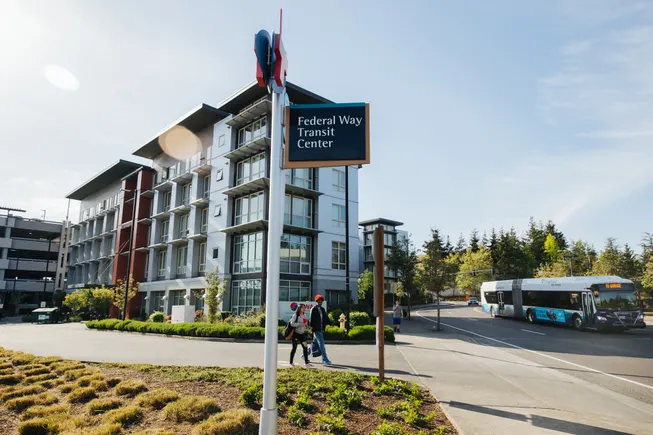
When transit agencies in the Seattle metro area build stations, their goal is to use space as efficiently as possible. Land is expensive. So when Sound Transit built the Angle Lake Station in 2016, there were still 33,500 square feet of space left in the parking lot.
That space isn't just for landscaping. Sound Transit is selling the land in South King County to a nonprofit at below-market rates, which will build affordable housing with ground-floor commercial or office space.
"We really thought carefully about designing our stations so that land that might be needed during construction could later be used for transit-oriented development," explained Thatcher Imboden, Sound Transit's director of land use planning and development.
As transit ridership declines nationwide and housing costs rise, cities are pushing mixed-use projects around transit and rail stations, known as transit-oriented development (TOD).
Angle Lake Station is just one example of TOD. Cities like Los Angeles, Orlando, and Chicago already have TOD projects operating or underway. The Federal Transit Administration is awarding $11 million to 20 projects in 12 states through a pilot program, with funding increased from last year, partly due to the bipartisan infrastructure law.
City leaders hope TOD will provide more housing and retail space while making it easier for people to use public transit instead of driving. At the same time, cities and transit agencies must ensure TOD benefits existing residents.
How Seattle is using leftover space at transit stations
Sound Transit has already undertaken such projects throughout the Seattle metro area. The agency owns 2,500 housing units, mostly rental, with 795 completed and occupied. Imboden said about 64% of the housing units are affordable.
To achieve this, Sound Transit focuses on building partnerships with developers, local jurisdictions, and public and private funders.
"Land prices in the Pacific Northwest and the Seattle area overall are very high," Imboden said. "So even if we donate the land, the cost of building affordable housing is still high and requires other resources to make it happen."
At Angle Lake Station, Mercy Housing Northwest will handle the TOD development and build at least 85 affordable housing units. The nonprofit will purchase the land at a discounted price of $300,000 to $400,000. Deed restrictions will ensure the housing remains affordable for 50 years.
Meanwhile, a developer will purchase another piece of land at Angle Lake Station for $1.95 million to build at least 230 housing units, with 20% affordable and the rest mostly market-rate.
When screening developers and concept proposals, Sound Transit provides funding support along with the land. Imboden said this is an effective way to ensure public entities like cities and counties work toward the same goal, reducing risk and speeding up delivery while helping developers coordinate the various public agencies involved in the project.
"Integrating a lot of resources upfront helps reduce that cycle of figuring out how to move the project forward," he said.
Cities and agencies must also be careful that these developments don't exacerbate gentrification.
Scholars worry TOD could replace more affordable housing with luxury housing, and new residents may not use transit, said Anastasia Loukaitou-Sideris, distinguished professor of urban planning at the UCLA Luskin School of Public Affairs.
While co-authoring a 2019 book on TOD's impact on neighborhoods, Loukaitou-Sideris studied whether gentrification occurred around new transit stations. The team looked at the San Francisco Bay Area and Los Angeles and found neighborhoods with transit stations were more likely to gentrify than those without.
"We're not arguing to stop transit-oriented development because it can have positive impacts, but rather to find ways through policy to protect existing residents in these communities from displacement," Loukaitou-Sideris said.
Building affordable housing near transit is an effective tool to prevent displacement, said Patience Malaba, executive director of the Housing Development Consortium, a nonprofit housing developer organization in Seattle and King County.

The Angle Lake TOD prioritizes family-sized housing, which is especially needed in South King County, home to many Black, Indigenous, and communities of color, Malaba said. But it's not just about building housing. Public entities must use strategies around land use, zoning, maximizing density, and subsidizing affordable housing to help residents stay in the community.
"The equity issues of transit investment are very clear," she said. "When these investments come online, we know the typical impact is that land and property values in certain areas skyrocket. It's important that we proactively think about how to advance investment while helping people stay in the community."
Transit-oriented development in a gentrifying neighborhood
In Atlanta, the metro area's transit agency is advancing its own TOD projects. The Metropolitan Atlanta Rapid Transit Authority (MARTA) is accepting proposals for future development at the Bankhead rail station, which has about 235,000 square feet of land available in northwest Atlanta.
The Bankhead neighborhood, where Atlanta rappers T.I. and Shawty Lo grew up, faces the threat of gentrification. In addition to rising home prices citywide, Bankhead is under specific pressure. Microsoft is developing a 90-acre campus in this low-income community, and Georgia lawmakers subsequently allocated $6 million to update the rail station.

MARTA is expanding the station to accommodate eight cars by 2025, rather than the current two. The transit agency sees the project as a prime opportunity for TOD, said Debbie Frank, MARTA's director of transit-oriented development.
"We really see the opportunity to bring new capital into these communities," Frank said.
It's unclear whether the development will include housing, as it depends on the proposals received. But if it does, 30% of units must be for individuals earning between 80% and 120% of the median household income (by ZIP code). Frank said there are two ZIP codes within a one-mile radius of Bankhead Station, with median incomes of $39,500 and just over $25,000.
MARTA is also partnering with Morgan Stanley and the National Equity Fund to create a $100 million fund to preserve affordable housing within one mile of MARTA stations.
For the upcoming TOD, MARTA has not yet engaged with Bankhead residents. That will happen after a developer is selected.
Matt Garbett is skeptical about whether the project will truly be beneficial.
"If you move this development away from the train station and it doesn't change anything, then it's not TOD," said Garbett, co-founder of ThreadATL, a nonprofit advocating for 'good urbanism.'
"It has to be designed around the train station as its core," Garbett said.
TOD must have multiple uses. "We call it the three T's: tomatoes, tequila, and toilet paper," he said. Everyone needs to be able to buy produce, relax, and use a restroom, he explained.
Planners must create something useful for existing residents, not just new ones, Garbett said. It must be a hub of goods, services, and housing. For the Bankhead TOD, in addition to ensuring no displacement of existing residents, the main street where the station sits must be considered.
"The road itself is a six-lane nightmare; no pedestrian would feel comfortable walking out there. So does TOD ease traffic? Does it improve access to goods and services?" he said. "Or is TOD just building some apartment buildings next to the train station, mainly so people can walk to Microsoft?"
Looking ahead
Over the past decade, public transit ridership nationwide has steadily declined, and the COVID-19 pandemic dealt another blow. Loukaitou-Sideris said cities cannot forget this when developing TOD.
"One of the elements of transit-oriented development is transit, and if transit ridership declines, then what happens to TOD?" she said.
Still, with the Infrastructure Investment and Jobs Act authorizing up to $108 billion in public transit funding, new TOD projects should have more opportunities, said Michael Duncan, associate professor of urban and regional planning at Florida State University.
As the U.S. population ages, these developments must also serve older adults, Duncan said. In a study of major transit stations nationwide, he found older adults are less likely to live in these areas. So municipalities have an opportunity to promote TOD for people who may no longer be able to drive.
UCLA's Loukaitou-Sideris said anti-displacement measures could include expanding rent control and inclusionary zoning, as well as providing eviction assistance for tenants.
Seattle's Malaba said partnerships and dialogue with community members are key to achieving equitable TOD.
"It has to be through extensive, deep community engagement, not just showing slides to the community, but really understanding their vision," she said. "They know the solutions that work best for them."